



Kratom is made from the leaves of the Mitragyne Speciosa tree. This tree grows primarily in Southeast Asia.
Kratom trees are mainly found on Borneo and Sumatra in Indonesia, and in Malaysia on the Malay Peninsula and in the south of Thailand. Kratom trees also occur in Papua and Myanmar (Burma).
Basically, three types of Kratom are distinguished: red, white, and green kratom. This is because Kratom leaves can have a white, green, or red vein and stem.
The quality of kratom depends on a number of factors, including sunlight, age of the trees, soil type, harvest time, harvesting method, etc.
- The age of the trees. Generally speaking, the leaves of older kratom trees have a higher alkaloid content than those of young trees
- Wild or plantation trees; The leaves of trees growing wild in the rainforests are generally of higher quality compared to the leaves of plantation trees, partly due to the age of the trees (plantation trees are often younger).
- The harvest time and weather conditions during the harvest are also important for the quality of the leaves
- The method used for harvesting, drying, and processing the leaves is likewise of crucial importance for the final product
- The soil type on which the trees grow also partly determines the alkaloid content. Therefore, one cannot directly say that the leaves of trees harvested in a certain region are (always) better than those in another region. The conditions at the location in question are also important.
During the processing of the leaves into kratom, the stem and veins are removed from the leaf.
The stem and veins can be sold as separate stem and vein powders. We sell only and exclusively pure kratom powders.
We sometimes also sell stem and vein powder, if available, but then as a separate type/product.
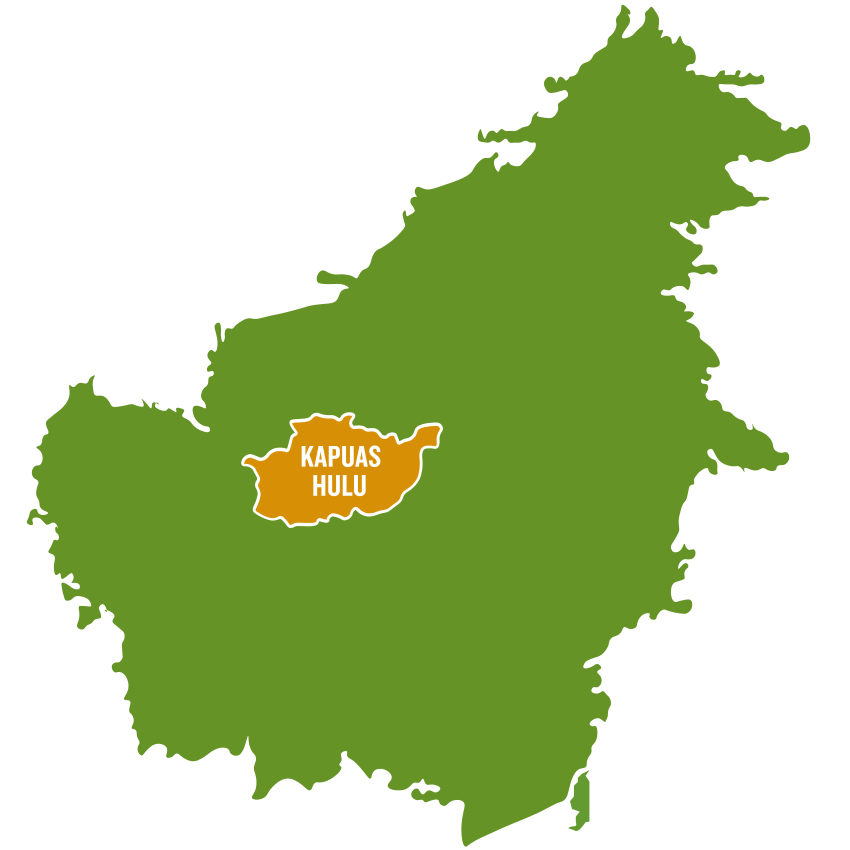 Most of the kratom we sell comes from
the "Kapuas Hulu" (Kabupaten) area. Kapuas Hulu is the northeastern part of West Kalimantan. While in a large part of West Kalimantan (especially the lowlands
around Pontianak), the rainforest has unfortunately already been cleared everywhere, the Kapuas Hulu area is still largely covered with original rainforest.
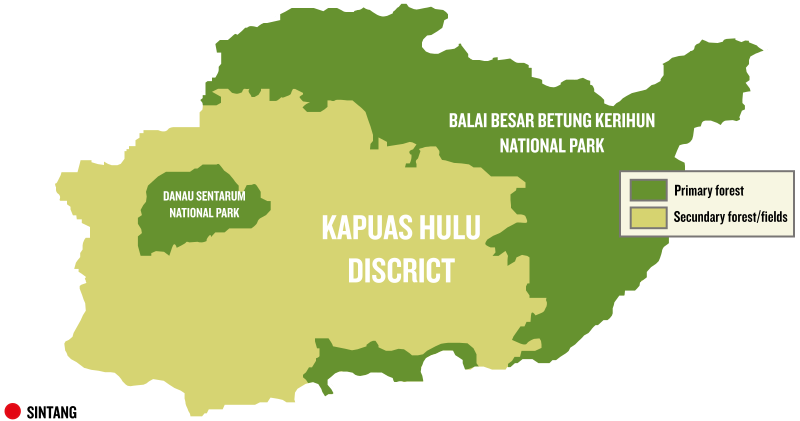
Kapuas Hulu is, in fact, part of the so-called "Heart of Borneo" nature reserve, and as a result, the area is still covered by at least 70% primary rainforest
and is under protection. This means that many old kratom trees still grow in this area; they are not allowed to be cut down, but their leaves may be sustainably
harvested for the kratom harvest. This is mostly done by the Iban families who manage many kratom trees in this area. The Iban farmers sell the leaves to my suppliers,
some of whom have their drying facilities in the city of Sintang.
I have visited this area regularly myself (the last time was February 2018) and hope to go there often in the future.
Kapuas Hulu
Kapuas Hulu is not covered by an estimated 40% primary rainforest. Fortunately, A part of the area has been protected in the Balai Besar Betung Kerihun park since the 1980s.
However, this does not mean that the area is out of danger. Logging also takes place in the rainforest. Balai Besar is part of the large transnational "Rainforest of Borneo"
area, a largely mountainous region located partly in Indonesia (Borneo) and partly in Malaysia (Sarawak).
Feedback sturen
Most of the kratom we sell comes from
the "Kapuas Hulu" (Kabupaten) area. Kapuas Hulu is the northeastern part of West Kalimantan. While in a large part of West Kalimantan (especially the lowlands
around Pontianak), the rainforest has unfortunately already been cleared everywhere, the Kapuas Hulu area is still largely covered with original rainforest.
Kapuas Hulu is, in fact, part of the so-called "Heart of Borneo" nature reserve, and as a result, the area is still covered by at least 70% primary rainforest
and is under protection. This means that many old kratom trees still grow in this area; they are not allowed to be cut down, but their leaves may be sustainably
harvested for the kratom harvest. This is mostly done by the Iban families who manage many kratom trees in this area. The Iban farmers sell the leaves to my suppliers,
some of whom have their drying facilities in the city of Sintang.
I have visited this area regularly myself (the last time was February 2018) and hope to go there often in the future.
Kapuas Hulu
Kapuas Hulu is not covered by an estimated 40% primary rainforest. Fortunately, A part of the area has been protected in the Balai Besar Betung Kerihun park since the 1980s.
However, this does not mean that the area is out of danger. Logging also takes place in the rainforest. Balai Besar is part of the large transnational "Rainforest of Borneo"
area, a largely mountainous region located partly in Indonesia (Borneo) and partly in Malaysia (Sarawak).
Feedback sturen
The kratom products on this website are not intended for human consumption